Monday, July 16, 2012

The New Arrival!


My wife, Meenakshi, and I were getting used to the life in Kampala in our respective fields. She being a raw hand in teaching was given a firm encouragement and positive support by her boss, the head of Makerere University's Biochemistry Department, Professor Bosa. This went a long way in boosting her confidence in herself in those initial stages of her career. My work was cool in the hospital as usual, without any major excitements, much unlike the experiences in the interior.

As life was moving on, we were expecting our first child soon in April, 1976. Meenakshi was carrying on with her normal routine work at home, her teaching work and our social engagements. It was Easter time and there were four holidays including the weekend. As  per routine we visited the Gurudwara  and some of our friends on Sunday. Meenakshi was not all that well and she showed some signs of pain and discomfort by evening. I got her admitted to the nearest Rubaga Hospital at about 11 PM. Rubaga Hospital was just about10 minutes drive from our abode. By next day she had been in labour pains for almost about 24 hours. A young German doctor on duty seemed to be very busy attending to some other patients as well. Since I happened to be there, he asked me to take care of her in the labour room itself. It was then that she delivered our first born a son. It happened to be Easter Monday evening. 

It was a great relief and time for jubilation since the delivery was normal, smooth, safe and without any complications with the grace of Almighty God. A few hours after delivery, she was moved to the room and asked to take a bath as against our traditions in India with so many taboos and rituals associated with post delivery period. All went well against so many odds. Justice Asthana had to delay his departure for circuit duty to Mbale the next morning, because he wanted to be around at this critical juncture and also because, as per Indian traditions, he wanted to feed our newborn some honey (shahad chatana). To our son, he was his always his Nanaji (maternal grandpa).

That was the occasion when we could see so many acquaintances coming forward to give us a helping hand in that strange land of Uganda where essential commodities were very much in scarcity. We cannot forget all those little gestures, which never made us feel out of place. All were so keen to celebrate the occasion with full gusto. On 10th day after the birth, a havan was solemnized.  The Sehgals, Uppals, Raos, Asthanas and Goyals assisted us in organising the prayer function. These wise and elderly couples alongwith  some other friends were like parental figures for us. I am so sad to state that many of them are no longer in this world now. It was during the havan that Mr Uppal insisting on naming the baby and we decided to call him Rajeev!

As per Indian traditions, we were not supposed to use the new clothes for the new arrival. Hence some old and used clothes were provided by one Mr. Lotay of Entebbe, who later migrated to Canada. When in Masaka, before moving to Kampala, we met a very humble and amiable Pakistani teacher, Mr. Bhatti, from Petaro, Pakistan. His wife had made a very kind offer to stitch dresses for the baby. On our shifting to Kampala and as they learned of the birth of Rajeev, Mr. Bhatti made a special journey to Kampala to deliver the clothes. We didn’t have enough words of thanks to convey our feelings to this Bhatti family of Pakistan. Only we can pray to God to shower His blessings on them. These are some of the great experiences we had in that land, for which we are so nostalgic.


Time passed and both of us were managing to look after Rajeev. Our houseboy was there to help with the household chores, and an ayah (nanny) was also engaged to take care of Rajeev during Meenakshi’s duty hours, which were quite minimal after one month of maternity leave. That was the understanding in her department. We were fortunate to have enough time at our disposal  between two of us to look after our child. 

A new problem cropped up. For a proper communication between ayah and Rajeev, we had to make sure that we talk to him in English and he learns how to speak and understand the language and be able to communicate with his ayah, who were using broken English. He started picking up the language well and could convey meaningfully to some extent as best as a child could do at that age of one or one and a half.

Friday, June 15, 2012

Hakuna Matata, Kampala!

Once formalities completed for us to move, we shifted to Kampala in February, 1976. After a few hurdles, we got a house allocated in the Mutagwanya Estate near the Rubaga cathedral, with its Rubaga Hospital managed by German doctors, about four miles away from our working places in Makerere University and Mulago Hospital. The housing estate was situated on the Rubaga hill and it had a very beautiful view of Kampala city. The estate had 10-12 beautiful independent houses, each with a lush green grassy lawn with trees around that made it very pretty. 

Settling down in Kampala became much smoother with the great and timely help of the Asthanas. Till today, we can’t forget their help and feel greatly obliged towards them. Our ties with them as a family grew stronger and stronger as the time went on. 


Kampala enjoys a wonderful location, closer to the Lake Victoria at an altitude of 3,900 feet, on seven hills, namely, Kampala, Kasubi, Mengo, Namirembe, Rubaga, Nsambya, Kololo plus others like Nakasero, Tank, Mulago and Makerere hill. Kampala is not very far from the Equator. Close proximity to the lake coupled with a good altitude makes the climate very pleasant, with temperatures varying between 20-30 degrees Celsius with frequent tropical rains and the greenery around.

As the tropical rains were very frequent, temperature used to come down significantly and the roads and pavements got cleaned up - giving the city an even more beautiful appearance. Words cannot do justice to what this feels like -- one has to experience it to know it.

We reported at our places of work and started our duties diligently. Meenakshi started her work at the Department of Biochemistry, Makerere University. The university has a beautiful campus on Makerere hill with various departments and housing complexes for staff -- good independent houses and apartments in the form of flats in larger buildings. Makerere was once a great university, considered the best in East Africa -- the likes of VS Naipaul and Paul Theroux, both great writers, taught there in the 1960s. In fact, Paul Theroux, who lived in an apartment on the campus, wrote about his return to Makerere after three decades in his travel book Dark Star Safari.

Dr. AJ Lutalo Bosa, Head, Department of Biochemistry and Meenakshi's boss, was very humane and understood very well the hesitations and apprehensions of the newcomer. That made the settling-in in teaching an easier process for her.

Kampala being the capital, was far more cosmopolitan and had quite a good expatriate community. Despite the 1972 exodus, Kampala still had a huge number of Indians. Being in Kampala brought us close to to our own countrymen. Meera Rao who lived on the university campus was a great friend and was like an elder sister or mother for Meenakshi in difficult times. Mrs. Meera was an excellent cook and we still remember her cooking. Her good advice or suggestions were solicited and welcome. Her husband SRA Rao was with the UNDP and attached to the Department of Statistics at Makerere. They had two loving kids - Shivkumar and Shambhavi.

Amongst the old timers were the Bowry brothers who were elderly and like our parents. Their wives happened to be real sisters too. They hailed from Ludhiana, Punjab, and were originally working with the legendary East African Railways and later became builders. With their progeny well settled in Nottingham, UK, they were merely enjoying a retired life on their properties here and remembering good old days.

At the Bowrys' place we happened to meet Dr. Berry, who was working for the WHO. His daughter-in-law Ritu Beri is a world famous fashion designer today.


Another important friend, Kaka Harjeet Singh was a very good car mechanic and his Ismaili wife was a very good host. They had four sons, the younger two were twins, never still and real naughty. He used to help us maintain our old Ford Escort.as a special case, though he was catering for the police vehicles only.

I was assigned to the old Mulago Hospital in the General OPD. My stint at Mulago was more of a sedentary sort of life with hardly any emergencies. It was a lot different from what I used to have in the hospitals upcountry which had the minimal necessary staff and posed a real challenge regarding how to manage our patients well. Soon life started to come to a normal track and we were getting used to it gradually. Of course I would have occasional duties in the Casualty Department on Sundays to relieve other doctors. Those days Mulago Hospital was very modern, with six storeys. It was a teaching hospital and referal of repute in East Africa. The new building had been inaugurated by the Duchess of Kent in 1962 and was a gift of the British government to the people of Uganda at the country's Independence. On its rolls were famous and dedicated faculty like Dr. Dennis Burkit, known world over for Burkit’s Lymphoma and Prof. SMM Karim who is renowned for research on Prstaglandins as well as Prof. Krishna Somers, who is now settled in Australia.

It was always a good experience to interact and mix-up with so many people from various sections, from the hospital, university, UNDP experts, the locals long settled in businesses. But they were now devoid of all that enthusiasm because of  Amin’s policies. That made the well-minded professionals upset and a little depressed. There is no denying the fact they had toiled with their blood and sweat to bring their businesses and enterprises to such great heights.


The temples and gurudwaras were good social meeting places for all of us especially on Sundays and on festive seasons. The community lunch, langar, in Kampala's gurudwara, was a welcome change for homesick people like us, who are used to eating the simple dal roti in India. We used to relish this food  from the core of our hearts. Even more enjoyable were the interactions with the friends from a cross-section of the society comprising Indians, Pakistanis, Bangladeshis and Europeans. The atmosphere was so congenial and friendly despite all the problems Uganda faced. The Akhand Paath, Dussehra, Holi and Diwali were special occasions to celebrate with all the people flocking in great numbers with all the gusto. Dandia and garba dances by the Gujaratis were a treat to watch. For people like us from north India, it was something novel, special and very graceful. It was an exhilarating experience worth mentioning.and enjoying.

Despite shortages of essential commodities, security problems and the greater risk of venturing out at night, there was a spirit of taking life as normal and facing it boldly. That’s how the Ugandans went about their business as usual dismissing all their worries with a casual remark of Hakuna Matata, Swahili for ‘no problem’!!!!

Sunday, May 20, 2012

Oneness with Nature!


By 1975, I had been in Uganda for almost five years, and had been quite busy with my professional work plus facing the problems associated with the exodus of the Asians. So far, we hadn't been able to visit any National Park in the country. Now since my wife Meenakshi had also joined me in Masaka, we decided to finally have a little break and go on a safari and see the animals in their natural habitat.

The very famous Murchison Falls with its National Park was renamed by Idi Amin as Kabarega National Park in the 1970s, after King Kabarega  who reigned over Bunyoro around the end of the 19th century. The King had resisted colonization by the British, was arrested and was exiled by the British to the Seychelles. King Kabarega died in Jinja, in 1923 en-route to Bunyoro while returning from exile. This episode always sounded so familiar to what had happened in India, when the freedom struggle was being fought.

The change in name was never legally promulgated. The name of the falls and the national park reverted to Murchison Falls following the downfall of Idi Amin. This area was explored by a British explorer, Sir Samuel Baker, in the 1800s, who christened the falls after Sir Roderick Murchison, the then president of the Royal Geographical Society.

We drove to Hoima in our Ford Escort. The journey from Masaka to Hoima via Kampala was an exciting first long drive for us as a couple. It was a pleasant experience to be together on this journey. The weather was fine, though not very cool as the month of December is usually dry around these parts and the greenery also diminishes a bit. 

At Hoima, we spent the night with Dr. Rajendra Kumar and his family. Dr. Kumar had been there since I left Hoima, and was living in the same house where I had lived while in Hoima. Being there once again felt good even though we were there for a short while only. Dr. Kumar had a very energetic and lively 3-4 year-old son, who was very social and hospitable. It was he who would offer beer and insist on replacing the bottles once they were empty, and also would remind us to replace them in the fridge. It was quite amusing to see him work like that. Not only that, he was also sipping from his father's glass but his parents did not seem to mind it or were rather encouraging I would say. After a good night’s rest we started off for the park early in the morning. Dr Kumar and his family joined us for the trip to Murchison National Park. Hoima to Murchison Falls and National Park took us about three hours.

On reaching Murchison National Park, we had some snacks and rested a while in Paraa Safari Lodge which is tucked away in this away beautiful hideaway far from the urban locales. Paraa is now owned by the Madhvani Group, a business conglomerate, owned by an Indian family. Incidentally, the Bollywood actress married the scion of the Madhvani family in 1974. Indeed, India has been tied to Africa in countless ways!

Then we roamed around in the park and enjoyed some stunning views. We saw quite a few baboons, elephants and hippos in the water. This was the first time we had seen animals in their natural habitat. The lodge was full of tourists of various nationalities, enjoying the sight of wild animals in their natural environment and relishing the hospitality of the Ugandans. There was a lot of hustle and bustle. It was a very good and refreshing change for us in a relaxed atmosphere, far from the turmoil of the city.

Watching the wild game in the National Park was an amazing yet exclusive experience. We were amazed how the droves of animals roamed about freely, oblivious of human beings around them close by clicking the cameras to capture them. A strange thought crossed the mind that we are now viewing these animals at close quarters and admiring the creations of nature in their own environs roaming about, yet we leave no opportunity to poach and kill them for sport or food. It may be for relishing the game meat or for trophies to be displayed very proudly in our living rooms. We tend to derive a great pleasure out of all these misadventures of ours. How nice it would be if we can have a peaceful and meaningful coexistence on this planet. Then there wouldn't be any danger of extinction of some of the species which are already rare to find. Those will just be in history books for our future generations to learn and see their pictures like the dinosaurs which disappeared from this earth millions of years ago. Surely, it does help to be in tune with Nature and its beings, that's what Africa taught me.

But at that moment, Meenakshi and I felt the oneness with Nature!

Sunday, May 6, 2012

The Next Phase in Masaka

Two years of hectic activity in Hoima after the exodus of Asians was a unique experience. To work there in the country with depleted work force and the absence or near absence of essential things was a great learning period for doctors like me who were there and had to see that the services continue as normally as possible. For that one had to be imaginative, learn to live with minimal needs and innovate here and there, not only at home with regard to food , and also in the hospital while dealing with the sick patients. Working to the maximum capacity under those trying conditions and achieving satisfactory or good results was there to feel rather than describing on the paper in a few words. One does get the feeling that a human being has a lot of potential. Sadly this potential is not exploited.to its maximum for fear of failure or lack of guts or incentive or all combined together.

Now, it was a time for me to proceed on vacation to India in January, 1975. I had to be home by the third week of the month in order to be able to participate in the marriage ceremony of my youngest sister, whereas the elder one to her had already been married in October, 1974 in my absence. I started my journey well in time for that. Boarded the flight in Entebbe and arrived in Nairobi. The connecting flight from Nairobi to Bombay was delayed from London by 7-8 hours because of fog and the inclement weather. On demand the airline put  us up in a hotel in the mid of the town,called Hotel 680. The nomenclature appeared a little odd. Our first question to the receptionist was about the name of the hotel..He clarified that there were 340 double rooms in the hotel , hence, the Hotel 680. After that the flight to Bombay and Delhi was uneventful. I reached home just in time to partake in the marriage activities, and everything went well as planned.

I had a few quiet days of rest and then feverish activity of search for a suitable soul mate started through print media, of course. The quest ended towards the end of February and I got engaged to my wife, Meenakshi, and the wedding was solemnized in mid April. She had just completed her M.Sc. (Hons. School) in Biophysics from Panjab University in January. 

As my leave was about to end, I left for Uganda five days after the marriage. My wife was to join me later. The primary reason being the fear that without visa she may be denied entry in the country. However, later on it was confirmed that she will be provided with visa on arrival at the airport. Meenakshi arrived in Uganda in mid July,1975. We visited Mr. DK Goyal, Chief Roads Engineer based in Entebbe. They were like our parents and welcomed Meenakshi like a new daughter in law, which gave her a very good feeling in that far flung country. We continued to be in touch with the Goels, who later moved back to Delhi and settled in  East of Kailash.


Meanwhile, I was posted to Masaka Hospital, eighty miles south west of Kampala. There Dr MK De, was the Medical Superintendent. He was one of those 20 or so doctors recruited from India in 1969, I being one of them.

 In the initial days at Masaka, I had to stay in Hotel Tropic Inn till my house was ready for occupation after a week. I understand this hotel got destroyed in the bombing raids of liberating forces in 1979. 

Masaka at that time had a motley of expatriates of various nationalities, comprising Bangladeshis, Canadians, Dutch, French, Indians, Pakistanis and Russians. In the hospital there we had two Russian doctors, Magomedov, a surgeon and his wife a gynaecologist, two Bangladeshi doctors and a young Ugandan doctor as well.  There was one Dr Ronald Schuurs from the Netherlands, who was working in the bush at the Villa Maria Hospital, half way between Masaka and Kampala. We had a great interaction with his family.


We used to mix freely with one another without any prejudices. We used to often visit a Pakistani Magistrate, Justice Mehndi. He had migrated from Meerut to Pakistan in 1950s and his wife was from Lahore, a Punjabi. Mrs. Mehndi's Punjabi was like music to our homesick ears! The Mehndis would take care to ensure that our meals would be without beef, in deference to our religious sentiments. How times have changed now - I wonder how difficult would be interactions between Indians and Pakistanis today!

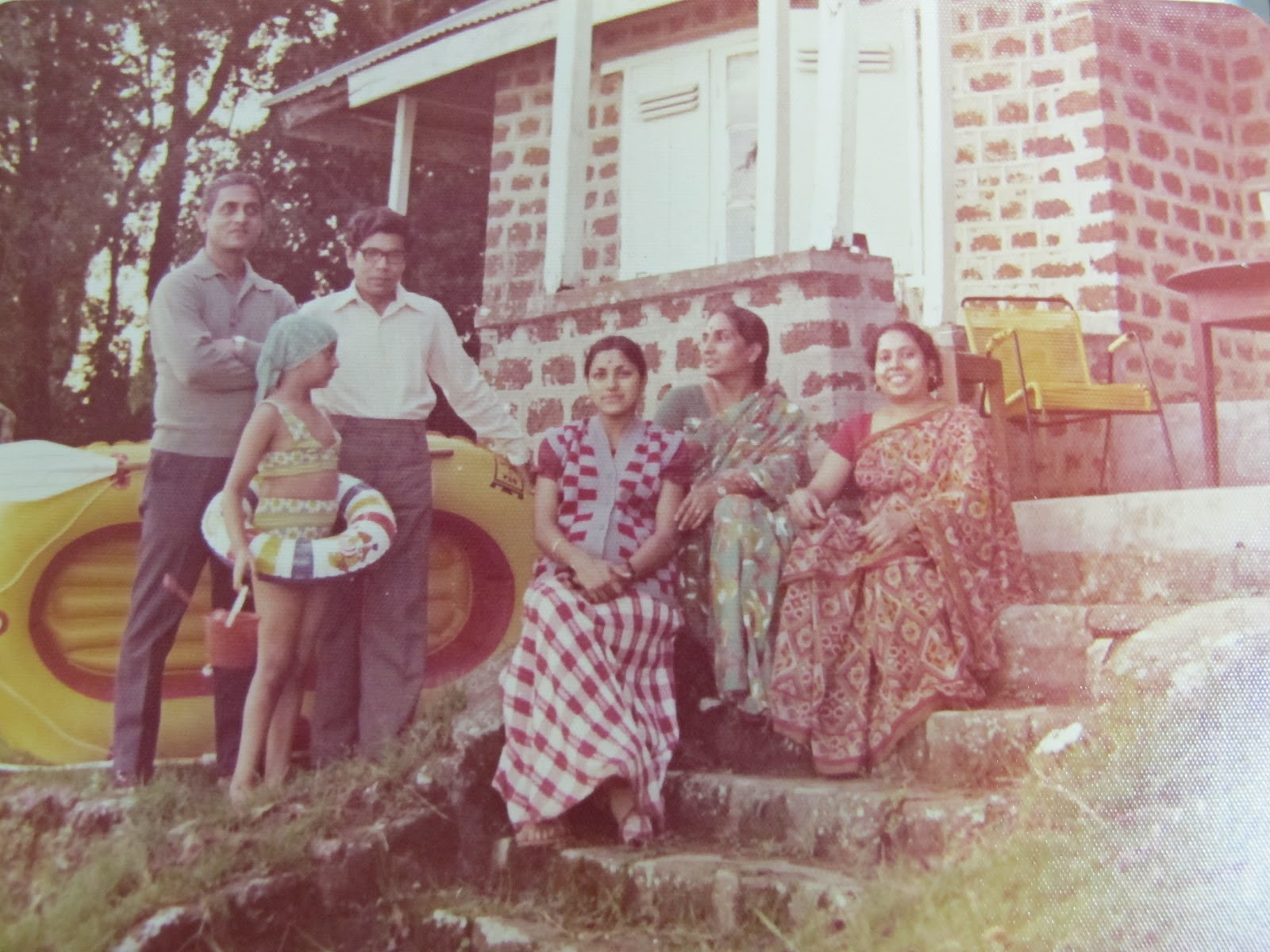
Along with the De family, Meenakshi and I took a few memorable weekend trips, including a boating expedition to Lake Nabugabo, near Masaka. Mr. Reddy (from Hyderabad), who was working with Tata Motors, in Kampala, joined us for the trip, alongwith his family. We stayed for two nights in the cottages on the shores of the lake, where early each morning, the fishermen would bring their fresh, early morning catch alongwith with some fresh fruit. This lake had the distinction of being the only lake in Uganda that was free from Bilharzia. The interactions we used to have with expatriates in Masaka, helped Meenakshi settle fast in the alien land.


But we must say that even Ugandans went a long way in making our lives a lot more richer. While we were in Masaka, we met a Ugandan District Education Officer (DEO), Mr. Katende. While conversing he got quite impressed with my wife's credentials, he immediately suggested that she must teach and must not sit at home, as there was a shortage of teachers there. Later, he spoke to the Headmaster of Kitovu Senior Secondary School and asked us to go and meet him. The Headmaster immediately appointed her as a teacher, and she started her teaching career. 

As and when we met again the DEO, he was of the opinion that she would be more suitable for the University and not for the school. On his insistence, we went and saw the Head of the Biochemistry in the University of Makerere in Kampala. He kept her testimonials and thesis for M.Sc. (Hons. School) for study. Later she was appointed as a Teaching Assistant and later a Lecturer in the Dept. of Biochemistry., and joined there in February 1976. 

Before she could start working there in the University, Dr AJ Lutalo Bosa, Head, Dept. of Biochemistry, gave me a letter of his intention of appointing Meenakshi in the University. The Health Ministry was quite amenable to transfer me to Kampala, saying that to get the services of two expatriates they will have to provide only one house, and one set of family air fare to India and back. Thus Uganda was gaining by utilizing the services of two officers. This gave a good foresight to their very pertinent thinking beneficial to their own country. With time, we developed a very strong bond with the Bosa family that still continues on till this day.

Years later, our daughter Neelima undertook a journey back to Uganda and met the Bosa family - she stayed with them for a day and they did lay down an impressive feast just like one would do for the homecoming of a loved one. Through the pictures, we could gather, it was a lot like a big family reunion.


Perhaps it is true that bonds like these do not depend on how often you interact. These bonds are timeless and priceless!

Monday, April 30, 2012

Building Bonds, Post Exodus..........

Life in Hoima was going on normally with lot of work to do and very busy day in and day out. I happened to meet a gentleman called Anton Pillai from Sri Lanka, who was working in a Tea Estate about 10 miles away from Hoima. It was good for me to know him and visit the family occasionally for a change. Of course they were regular visitors to Hoima for their shopping spree. They were quite regular in attending the Catholic Church on Sundays. He had two lovely daughters and a son.

The British Manager of the Tea Estate asked me if I could attend to their workers, who may need medical assistance, once or twice a week. I welcomed the suggestion and started attending patients twice a week. While going there the emergencies in the hospital were always on mind and had to keep pace with all that though it was a little tight and kept me on my toes. I was enjoying the work and meeting the challenges fairly well. Mr. Pillai's family left for Sri Lanka after a few months. He also followed suit after sometime. They settled in Jaffna, though he was working in Colombo. As we went on leave in October, 1977, we took British Airways flight, passed through Seychelles onward to Colombo and then India. There we happened to see the book, State of Blood, on Idi Amin and Uganda by our former Health Minister Henry Kyemba who had to go in exile to save his skin. We bought the book, read it and left it in India, because it was a banned book in Uganda. The book elucidated the atrocities and horrors committed by Amin and his unruly soldiers.  In Colombo, we met Pillai once again and caught up with each other. His elder daughter got married to a Norwegian and shifted to Oslo.

While in Hoima, I got acquainted with the Rev. Fr. Willie Audette, a Catholic Priest, who was a fatherly figure to me, very social and amiable. He was stationed in a parish 35 miles away. He used to visit Hoima very often for the basic needs and would always make sure to meet me. It was so kind of him to do that. I developed a close kinship with him which continued for many years afterwards. Pillai and I visited him in his parish and it was a treat to see how they were living in the bush with a nice pucca brick house with their own generator to provide electricity and to pump up harvested rain water in a concealed tank in the false ceiling from the underground tank. It was an eye opener for me to see all these luxuries in the jungle - much like jungle mein mangal. 

Life in Uganda was tough those days,  more so in the rural setup, but seeing all this gave an insight to the vision of the pioneers to surmount difficulties. In one of his letters Fr. Audette told of his first journey from  Canada to Uganda in 1936 to take up his priesthood took one complete month. Now a days it takes 24 to 48 hours, such a drastic change. On our trip to India in 1977, he sent a gift to one of his old friends, Dr. Barkat Singh who was once in Mbarara many years back and then returned to Jaipur to lead a retired life. Dr. Barkat also reciprocated by sending a shawl for him.

Later years when my wife joined me in Masaka in 1975 and we were relocated to Makerere University and Mulago Hospital, Fr Audette would always visit us and spend some quality time with us. She joined Dept of Biochemistry of the University  and I was attached to the Medical OPD in teaching hospital, Mulago Hospital in Kampala in 1976. 

As we decided to leave Uganda for good in 1981, Fr Audette didn't want us to go. He was trying to find a place for me in Kilembe Mines Hospital whereas he was located in Fort Portal at that time, even arranged an air ticket to enable me to go to Fort Portal for an interview. We had to decline the offer very politely since we had already decided to relocate ourselves in the greater interest of our family. 

A few years afterwards he also got retired and went back to Canada. There he went to Lennoxville in a house meant for the aged and retired priests. We were always in touch with him especially during Christmas and New Year, exchanging greetings and catching up with each other. In 1989, when he learnt that my son was interested in Africa and wildlife, he posted him a book titled 'Serengeti Must Not Die', which covered the journeys of a German father son duo - Bernhard Grzimek and Michael Grzimek, both zoologists, who extensively toured the Serengeti and Ngorogoro. We received the book over two years after he sent it, and it remains a prized possession in our household, till today!

In January, 1993, he wrote a very nice letter. Once there in Canada, he was feeling 'home sick', saying that he felt stranger among his own people after having spent more than 45 years in Uganda. Me and my family too feel very "homesick" a lot and do yearn to visit Uganda sometime!

In 1994, there was no response to our Christmas greetings from Fr. Audette. In 1995, again no response, but did get a reply from an unknown person but a friend of Fr Audette, also living there in that house informing us that Fr. Audette was no more and had left for his heavenly abode sometime back. It was so good of him to have conveyed this tragic piece of news which plunged us in grief, otherwise we would be in dark. That was the time for us to pray to God for this noble soul to find solace in heaven and to let us bear this loss with courage.

In our years abroad, we developed strong bonds with unknown people of different races and religions. That feeling of closeness was as great as a family-feeling, a very simple human bond, that perhaps is hard to build in today's materialistic world!  

Friday, April 27, 2012

Post Exodus Era At Hoima

Arriving in Hoima Hospital in Bunyoro district, in 1972, soon after the departure of Asians from Uganda was a unique experience. Psychologically, one would presume there was some sort of vacuum there, something missing and a feeling of discomfiture. I stayed in the Guest House for a few days till I moved to the house allocated to me about one and a half kilometer away from the hospital. 

Hoima is a nice small town in the western part of Uganda with a hospital of 60 beds. Besides me there was another Dr. DK Musisi who was also the Medical Superintendent. Just 3 months later he was promoted and posted in the Ministry headquarters in Entebbe. During the months we were together, we worked very closely and learnt a lot from each other. After his departure, I managed the hospital single handed for almost two years. It was a real adventure and bold experiments I had to undertake to help my patients on the road to recovery. I must mention here that once I took the plunge to do whatever I had to do for the benefit of the patient, I experienced success in 95% cases. The situation was that if you dare intervene chances of success were more than 90%, whereas if you don't then there is a strong, possibility of 90% fatality. That was a sheer delight in the wilderness there. A realization dawned on me that once you decide to do something after reading your books, your only companion to consult, with a firm determination to help your patient, God was always with you. This is what kept you going, and was a reward in itself so to say. Not a small thing, of course.

The life in Hoima was a little lonely in the beginning, atmosphere depressing. The shops left by Indians had been taken over by the Ugandans who had little experience in the businesses they were handling. Hence there was a chaos. Essential commodities like sugar, salt and edible oils were very much in short supply. Not to talk about brown flour (atta), though white flour (maida) could be obtained with some effort. Our staple diet of chapati would be made from a mixture of white flour mixed with soya flour to make it a little coarse. I must give credit to the new Ugandan businessmen who were always considerate and made these items available.to me saying that I was their guest and must have these things. Hats off to them for their great support in those times of scarcity and non- availability of essential items.

Just across the Hoima hospital, there was Hoima Club providing some sports like Table Tennis and drinks. I used to meet one young Ugandan there also interested to play Table Tennis. He was a Sugar Technologist, educated in the National Institute of Sugar Technology, Kanpur. His Ugandan girlfriend had done her graduation in Baroda with a scholarship from the renowned industrialists, the Mehta family of Lugazi. She could  speak Hindi / Gujarati fluently, and no one could discern if she was not an Indian girl when not looking at her.

By the time I landed there in Hoima, there was a Gujarati private practitioner Dr Patel who also left in a month or so. Three to four months later, one Mrs. Indu Asthana came and met me and I learnt that her husband, Mr.BB Asthana was a Chief Magistrate stationed in Masindi about 35 miles from Hoima..It was from then on that we became great friends, they were like my parents, where I would go on some weekends and find a solace far away from my own people.Our association with the Asthanas continued and is still going on, even with our children who are like their grandchildren. Later, Judge Asthana was promoted and became a High Court Judge in Kampala. Sadly, Judge Asthana is no more as he left for his heavenly abode when he had retired to London where his son is an Attorney.

Near Masindi a sugar factory was being erected by people from Walchandnagar Industries, Pune. They were mostly Maharashtrians, headed by one ND Rajpathak. There was a symbiotic relationship with them. Whenever any one will fall sick, they will seek my opinion and I would  enjoy their hospitality. It was  good for all of us there to have a nice time together and talk about home and compare the two countries, just for the sake of discussion. Some years later we were travelling to India on leave via Addis Ababa, Ethiopia. and were in a hotel. There was a pleasant surprise meeting with ND Rajpathak in the restaurant.There he was now engaged with putting up a sugar factory in Ethiopia. Seeing all this we were so proud to help our brotheren there on the African continent. India's association with African countries in their socio-economic development has been a historic one, and is still going strong.bilaterally. 

Sunday, April 22, 2012

Return from the Vacation

Arriving in India after 27 months was a real excitement, and meeting my own people at home was a sheer pleasure.Sharing my experiences of Uganda, the social life, climate, living conditions there, the simple folk, food  habits and the life style was of great interest to all. It was just a happy reunion with people at home. Life in India was simple as usual. Having landed in India during summer months, the sweltering heat of north was quite an experience after the pleasant cool climes of Uganda. Nothing unusual for me though.

Time was flying. Then got a breaking news and shocking indeed. In August, 1972, President Amin declared that all Asians (Indians) especially with British passports had to leave the country within 90 days. Nobody could believe it. The Indians were taken to Uganda Protectorate by the British in late 19th century, as labour was to lay the railway lines from the coast to the interior for the haulage of the produce from the country to Britain and the finished products from there to Uganda. It was to open up the interior, when the roads and communication were almost non existent. Those early Indians in Uganda and elsewhere did pioneering work. They constructed rail lines, maintained the services and run the rail traffic in an efficient manner. Later they diversified into small businesses, starting dukas in the remote areas in the countryside. As the time went on their progeny went into various professions, like medicine, teaching, nursing, engineering and accounting etc. Still later they started cotton and sugar cane production. Then gradually went into industrial processing of cotton, sugar, beer and glass etc. This is all well documented in the early history of East Africa. With the stroke of a pen, all this was to come to an end. Most of the Indians had to be out of Uganda in a period of three months. There was a lot of turmoil in Uganda.

As my time for return to Uganda was approaching, my apprehension was growing. I got in touch with Uganda High Commission in Delhi. I wanted to make sure whether the Ministry of Health in Uganda still required my services. So there was a correspondence in this regard and I was assured that my services were very much needed by the Ministry. I was of the opinion that I should not embark on my journey before the deadline set for the exodus of the Indians lest I land in the already troubled waters. Once the deadline had passed, I started my journey for Uganda by taking the Air India Boeing 707 flight from Bombay-Nairobi-Entebbe on 30 November. The plane was almost full and to my great surprise all disembarked in Nairobi. On the next leg of journey to Entebbe for one hour, I was the lone passenger in the flight. This gave a little uneasy feeling. The crew were also showing a surprise that I was heading for Uganda from where the Indians were fleeing from the torture of Idi Amin. It was on  that day that I had a queer feeling of a lone Maharaja travelling by the Air India flight. 

The plane touched Entebbe at about 4 in the afternoon. As expected, the airport was being manned by the young Ugandan soldiers, who wouldn't allow any Indian entering Uganda. There was an official from the Ministry of Health, Entebbe to receive me at the airport with a letter from the Ministry.  The soldiers were in no mood to listen to any argument to allow me in. The officer called the Ministry of Health from the airport and Dr. SLD Muyanga, Chief Medical Officer, rushed to the airport to solve this tangle. No amount of explanations or arguments could cut the ice with the soldiers. I was not one of those Indians affected by the expulsion orders of Amin, not being one of the old settlers, a businessman nor with a British passport but  an expatriate on contractual terms with the Government of Uganda. 

The plane was to head back at 5 PM. I was told by the purser on the plane that once I arrive in Bombay, they will have to keep my passport till I paid for the travel from Entebbe to Bombay for which I had no ticket. That done, the flight took off with a few Indians who were on their way to India. I was in a mental turmoil while on journey of one hour to Nairobi. As the plane touched the tarmac in Nairobi and we were proceeding to the transit lounge, somebody was asking for Dr. Gupta. I wondered I had no acquaintance in Nairobi and yet somebody is looking for me there. He was one Mr Kapoor, Airport Manager, Air India. He told me that he had received a telex message from Uganda to contact me and to issue me a ticket Entebbe-Nairobi-Entebbe if I am willing to go back to Uganda. I was in a bad state of mind and very furious and on the spur of the moment refused to go back. Mr.Kapoor was very cool, and offered me coffee and requested me to calm down and reconsider the proposal of the ministry of Health. The plane was to leave for Bombay after one hour. He asked me think about it  with a cool mind, and he would return in half an hour. Thinking with a cool mind about all the aspects, I decided to go back to Uganda and Mr Kapoor  gave me a ticket for a flight back to Uganda by an East African Airways flight to London via Entebbe at midnight. Again everyone on the plane was surprised to see me entering troubled waters.

The same official from the Ministry was there to see me through. This time there was no checking at all and the soldiers waved me on. I was lodged in Lake Victoria Hotel,  and in the evening Dr Muyanga came to see me and explained the whole affair how the problem got solved. After failing to solve the issue at the airport and as my plane started for Nairobi, he went back and contacted the Minister of Health, Dr Gesa who was in a cabinet meeting, among them one the Minister of Interior, who allowed my reentry and saw to it that the same soldiers remained on duty so as not to repeat the problem, and also got in touch with Air India officials there in Nairobi to authorize the issuance of the relevant ticket. It was a great relief for me with all that was going on in the country at that time. Brisk consultations and quick action on the part of various officials could solve this tangle to a satisfactory level. My own state of mind was in turbulence those days when I was resting in the Lake Victoria Hotel and waiting for my unaccompanied baggage to arrive. It took about a week, good for me to have a relaxed period and meet people of various hues and exchange views on very hot topics of those days. In the hotel, I met Dr I. N. Bhatia family who were leaving Uganda for good.. He left Hoima Hospital, where I replaced him.